Send Richard a voice mail message

Tuesday, May 11, 2010

Title of Lesson: What are the Five Steps Involved in Backward Design Lesson Planning? Part Three


When mentoring our pre-service and in-service teachers we need to describe and model both research-based and clinically tested best practices. This is one of many lessons we will be sharing on teaching Judaic content, lesson planning, models of teaching, differentiated and individualized instruction and learning activities designed to transform the classroom into a Jewish community of cooperative learners. The title of this lesson is “What are the five steps involved in backward design lesson planning?” Since there are 13 elements in each lesson plan we will divide this lesson plan into five parts. Here are the first and second parts of this five-part lesson on the five steps involved in Backward Design lesson planning. The third part of this lesson follows.

Step 3 continued from the previous blog post.

The teacher then says: “The first step of the ‘Backward Design’ lesson planning is to decide what Judaic content or knowledge is enduring. Now on the handout I distributed to you notice the second column, ‘Description of Each Step’, Record these words in the space provided in the second column: Decide what Judaic content or knowledge is enduring. As we have discussed in a previous lesson, enduring Judaic knowledge is the content that you want your students to learn during a particular period of instructional time (i.e. a lesson, unit, semester, or the entire year). An example of enduring Jewish knowledge is the Torah and the Talmud contain a body of wisdom that guide a person regarding how to lead a righteous and meaningful life. Therefore, record that sentence in the third column, ‘Sample Content Application’. See the example below:

4. Check for understanding, and extend and strengthen thinking skills. The teacher says: “In the fourth or last column of the handout, I want you to think together with your learning partner or partners and then record what you believe is an example of Judaic content or knowledge that is enduring. Remember this is essential Judaic knowledge that an educated Jewish person should understand. Here is a hint; enduring Judaic knowledge can relate to at least these seven categories or topics:”

· The Tanach (Hebrew Bible)

· Tefilah (Prayer)

· Jewish History

· Ivrit (Hebrew)

· The Hagim (Jewish Holidays)

· Israel

· Middot (Jewish Virtues)

· Other areas (e.g. Jewish culture, music, art, literature, science, technology, math, social science, etc.)

Provide your students with sufficient time to complete the last column.

Note: As an alternative, you can use nominal brainstorming for sharing this information.

In the next post we will share the fourth part of a five part lesson on Backward Design lesson planning.

Monday, May 10, 2010

Title of Lesson: What are the Five Steps Involved in Backward Design Lesson Planning? Part Two


When mentoring our pre-service and in-service teachers we need to describe and model both research-based and clinically tested best practices. This is one of many lessons we will be sharing on teaching Judaic content, lesson planning, models of teaching, differentiated and individualized instruction and learning activities designed to transform the classroom into a Jewish community of cooperative learners. The title of this lesson is “What are the five steps involved in backward design lesson
planning?” Since there are 13 elements in each lesson plan we will divide this lesson plan into five parts. Here is the first part of this five-part lesson on the five steps involved in Backward Design lesson planning. The second part of this lesson follows.

Introductory Activity: (Initial exercise to focus on the objective/learning outcome)

The teacher poses this question to his or her students: “Have you ever taken a long automobile trip (e.g. a two-week family vacation)? How did you or your family determine the distance to travel each day by car? Did you need to make any adjustments to your itinerary?”

Developmental Activity: (Set of procedures or steps to reach the objective/learning outcome)

1. Facilitate a classroom discussion on the questions posed in the introductory activity (i.e. Have you ever taken a long trip? etc.) making certain to include the concept of backward planning or planning with the destination or end in mind. Then make the point that today we are going to apply the concept of backward planning to lesson planning. Explain that Grant Wiggins and Jay McTighe have applied the idea of backward planning to lesson planning through what they call, Backward Design; that is planning lessons by first determining the enduring Jewish knowledge or understanding of the lesson. Then explain the five steps of Backward Design lesson planning that are described which you can find on this post.

Step 1. Get students ready to learn, and clarify the objective/s of the lesson. (This was discussed under item 1 under suggested motivation.)

Step 2. Present the advance organizer.

Step 3. Present new information.

Step 4. Check for understanding, extend, and strengthen thinking skills.

2. Present the advance organizer: The teachers says: “The ‘Backward Design’ approach of Wiggins and McTighe includes five steps. We will introduce each step in a systematic way, providing time to explain and give examples of how each step can be applied. Let’s start with the first step.”

3. The teacher presents new information to the students by first distributing the handout at the top of this post, The Five Steps of Backward Design Lesson Planning.

In the next post we will share the third part of a five part lesson on Backward Design lesson planning.

Friday, May 7, 2010

Title of Lesson: What are the Five Steps Involved in Backward Design Lesson Planning? Part One


When mentoring our pre-service and in-service teachers we need to describe and model both research-based and clinically tested best practices. This is one of many lessons we will be sharing on teaching Judaic content, lesson planning, models of teaching, differentiated and individualized instruction and learning activities designed to transform the classroom into a Jewish community of cooperative learners. The title of this lesson is “What are the five steps involved in backward design lesson planning?" Since there are 13 elements in each lesson plan we will divide this lesson plan into five parts. Here is the first part of this five-part lesson on the five steps involved in Backward Design lesson planning.

Enduring Jewish Knowledge Rationale for the Lesson: We have previously established that a parent is obligated to teach or hire a teacher to instruct his or her child in the study of Torah. Judaic lesson planning is a mitzvah in that the teacher is preparing a written and thoughtful strategy to engage students in the study of Torah, la’asok b’divrei Torah. The lesson plan itself is designed to motivate and empower students to acquire, apply, and create Judaic knowledge.

Essential Question/s: What is a lesson plan? What are the eight essential elements of a lesson plan? What are the five steps in Backward Design lesson planning?

Objective/Learning Outcome: (What the student is supposed to learn from this lesson) In his or her own words, the student will be able to:

  • Define a lesson plan
  • Identify and explain the eight essential elements of a lesson plan
  • Apply the five step Backward Design process to a lesson plan

Name of the Active Learning Procedures: Ticket In (on the 8 essential elements of a lesson according to M. Hunter) and the Presentation Model of Teaching

Anticipatory Set: (Motivation activity that prepares students for the learning outcome)

Suggested Motivational Statement:

1. Teacher says: ”Today we are going to discuss the five steps in Backward Design lesson planning. Before we do that, let’s review what you’ve learned in our last lesson by doing an activity called Ticket In. Ticket In is the reverse of what we did at the end of our last class. That closure activity was called Ticket Out. With Ticket In I pose a question or set of questions, and when all the students in our class can correctly answer those questions, we will then begin our exploration of the topic for today, Backward Design Lesson planning. So now I’m going to record these eight questions on the board, and I want you to make certain that you and your learning partners can answer these questions before we begin our investigation of Backward Design.”

· What is a lesson plan?

· What is an objective or learning outcome?

· What is an anticipatory set?

· What is an introductory activity?

· What are developmental activities?

· What does guided practice mean?

· What are assessments?

· What does closure mean?

Note: You can place students in dyads, triads, or quads.

2. After grouping your students, giving them time to discuss, and answer the above questions; then conduct a brief class discussion on those eight questions, and proceed to the introductory activity.

In the next post we will share the second part of a five part lesson on Backward Design lesson planning.


Thursday, May 6, 2010

Title of Lesson: What is a Lesson Plan? What are the Eight Elements of a Lesson Plan? Part Three


When mentoring our pre-service and in-service teachers we need to describe and model both research-based and clinically tested best practices. This is one of many lessons we will be sharing on teaching Judaic content, lesson planning, models of teaching, differentiated and individualized instruction and learning activities designed to transform the classroom into a Jewish community of cooperative learners. The title of this lesson is “What is a lesson plan and what are the eight essential elements of a lesson plan?.“ Since there are 13 elements in each lesson plan we will divide this lesson plan into three parts. Here are the first and second parts of this lesson on teaching mentees how to write lesson plans. The third part of this lesson follows.

Independent Activities: (Students practice new skill/s or strengthen previously learned skills outside of class.)

1. Students are to select a teacher or retired teacher whom they admire and with whom they would feel comfortable posing these three questions:

· What is a lesson plan?

· How do you write a lesson plan?

· How do you determine that your students have really learned the content that you have taught?

Note: Your teacher may tell you that he /she no longer writes formal lesson plans because he/she has taught the same lessons for many years, and his/her plans are memorized. You might then inquire about how he/she addresses the elements of a lesson plan (e.g. the objective or learning outcome, anticipatory set, assessments, closure, etc.).

2. Students then record the responses of the person they interviewed in their notebooks.

3. Students should be prepared to share what they had learned during the interview with their classmates.

Closure: (Activity that summarizes and ends the lesson)

1. The teacher summarizes the lesson by using the Ticket Out closure procedure. See the description of the Ticket Out closure procedure below.

Ticket Closure Procedure

· Teacher determines the question/s that individual students are to answer to summarize and end the lesson. In this lesson these are the closure questions:

· What is a lesson plan?

· What is an objective or learning outcome?

· What is an anticipatory set?

· What is an introductory activity?

· What are developmental activities?

· What does guided practice mean?

· What are assessments?

· What does closure mean?

2. The teacher then determines which question or questions individual students are to answer orally or in writing. When the students have correctly answered the teacher’s questions, instruction ends.

On the next post we will begin a lesson with this title: What are the Five Steps Involved in Backward Design Lesson Planning?

Wednesday, May 5, 2010

Title of Lesson: What is a Lesson Plan? What are the Eight Elements of a Lesson Plan? Part Two


When mentoring our pre-service and in-service teachers we need to describe and model both research-based and clinically tested best practices. This is one of many lessons we will be sharing on teaching Judaic content, lesson planning, models of teaching, differentiated and individualized instruction and learning activities designed to transform the classroom into a Jewish community of cooperative learners. The title of this lesson is “What is a lesson plan and what are the eight essential elements of a lesson plan?“ Since there are 13 elements in each lesson plan we will divide this lesson plan into three parts. Here is the first part of this lesson on teaching mentees how to write lesson plans. The second part of this lesson follows.

5. Select a student with whom to demonstrate and model how to do Co-op Cards[1]. An explanation of Co-op Cards appears below.

Co-op Cards

This is a paired three step cooperative procedure that was originally designed to help students master rote information such as the multiplication tables or the state capitals in the U.S.A. Co-op cards, however, can also be used for more complex cognitive operations such as defining and explaining the eight essential elements of a lesson plan.Assumption: Each student prepares a set of flashcards. On the front side of the card is a question ( i.e. What is an objective or learning outcome?); the reverse side of the card has the answer (i.e. The knowledge or the content that the student is supposed to learn). Let us call one student the tutor and his/her partner, the learner. During step one, the tutor shows and reads both sides of the Co-op card to the learner. The learner may write or trace the answer if needed. The tutor then shows the front side (i.e. question) of the card and asks for the answer. During step two, the tutor shows the question and asks the learner for the answer. During step three, the tutor poses the question without showing the card. After steps two and three, if the learner states the correct answer, he/she is praised and given the card. If the learner gives an incorrect answer, the tutor retains the card and gives the learner some helpful supplemental information.

Guided Practice: (Students apply new skill/s or strengthen previously learned skills during classroom instruction.)

1. Invite dyads to make and practice using their Co-op Cards on the eight elements of a lesson plan.

2. The teacher monitors how each dyad is following the rules for the Co-op Cards cooperative procedure.

On the next post we will share the third part of this three part lesson on how to teach mentees to write lesson plans.


[1] Co-op Cards is a cooperative learning procedure that is adapted from the work of Kagan, S. & Kagan, M. (2009). Kagan Cooperative Learning. San Clemente, CA: Kagan Publishing, www.KaganOnline.com.

Tuesday, May 4, 2010

Title of the Lesson: What is a Lesson Plan? What are the Eight Essential Elements of a Lesson Plan: Part One


When mentoring our pre-service and in-service teachers we need to describe and model both research-based and clinically tested best practices. This is one of many lessons we will be sharing on teaching Judaic content, lesson planning, models of teaching, differentiated and individualized instruction and learning activities designed to transform the classroom into a Jewish community of cooperative learners. The title of this lesson is “What is a lesson plan and what are the eight essential elements of a lesson plan?.“ Since there are 13 elements in each lesson plan we will divide this lesson plan into three parts. Here is the first part of this lesson on teaching mentees how to write lesson plans.

Enduring Jewish Knowledge Rationale for the Lesson: We have previously established that a parent is obligated to teach or hire a teacher to instruct his or her child in the study of Torah. Judaic lesson planning is a mitzvah in that the teacher is preparing a written and thoughtful strategy to engage students in the study of Torah, la’asok b’divrei Torah. The lesson plan itself is designed to motivate and empower students to acquire, apply, and create Judaic knowledge.

Essential Question/s: What is a lesson plan?

Assessment/s: (Initial, ongoing, and final activities designed to measure what the student has learned)

Students individually, in pairs, via classroom discussion and as a homework assignment discuss the answer to this question: what is a lesson plan?

Objective/Learning Outcome: (What the student is supposed to learn from this lesson)

In his or her own words, the student will be able to:

  • Define a lesson plan
  • Identify and explain the eight essential elements of a lesson plan


Name of the Active Learning Procedures: Co-op Cards and Ticket Out

Anticipatory Set: (Motivation activity that prepares students for the learning outcome)

Suggested Motivational Statement:

Teacher says: ”Do you know that many of the things that teachers do are not observed by their students? Think about that question for a moment. What things do teachers do before, during, and after class that (a) are not observed by students and (b) are designed to enable students to learn?”

Introductory Activity: (Initial exercise to focus on the objective/learning outcome)

The teacher then poses this question to his or her students: “What things do teachers do before, during, and after class that (a) are not observed by students and (b) are designed to enable students to learn?”

Developmental Activity: (Set of procedures or steps to reach the objective/learning outcome)

1. The teacher invites his or her students to individually record their answers to the above question (i.e. “What things do teachers do before, during, and after class that (a) are not observed by students and (b) are designed to enable students to learn?”) in their notebooks, and discuss their thoughts with a new learning partner.

2. Conduct a classroom discussion on the things that teachers do that students do not see by using the Numbers Method, an instructional procedure described below.

The Numbers Method

The teacher poses a question to the class. After some think time has elapsed, e.g. 10 seconds, students raise their hands indicating that they want to share something. The teacher then assigns each student whose hand is raised a number identifying the order for sharing information.

3. During the classroom discussion, if your students do not note the importance of a lesson plan as preparation for teaching, then give your definition of a lesson plan (i.e. a written and thoughtful strategy to engage students in the study of Torah, la’asok b’divrei Torah). The lesson plan itself is designed to motivate and empower students to acquire, apply, and create Judaic knowledge.

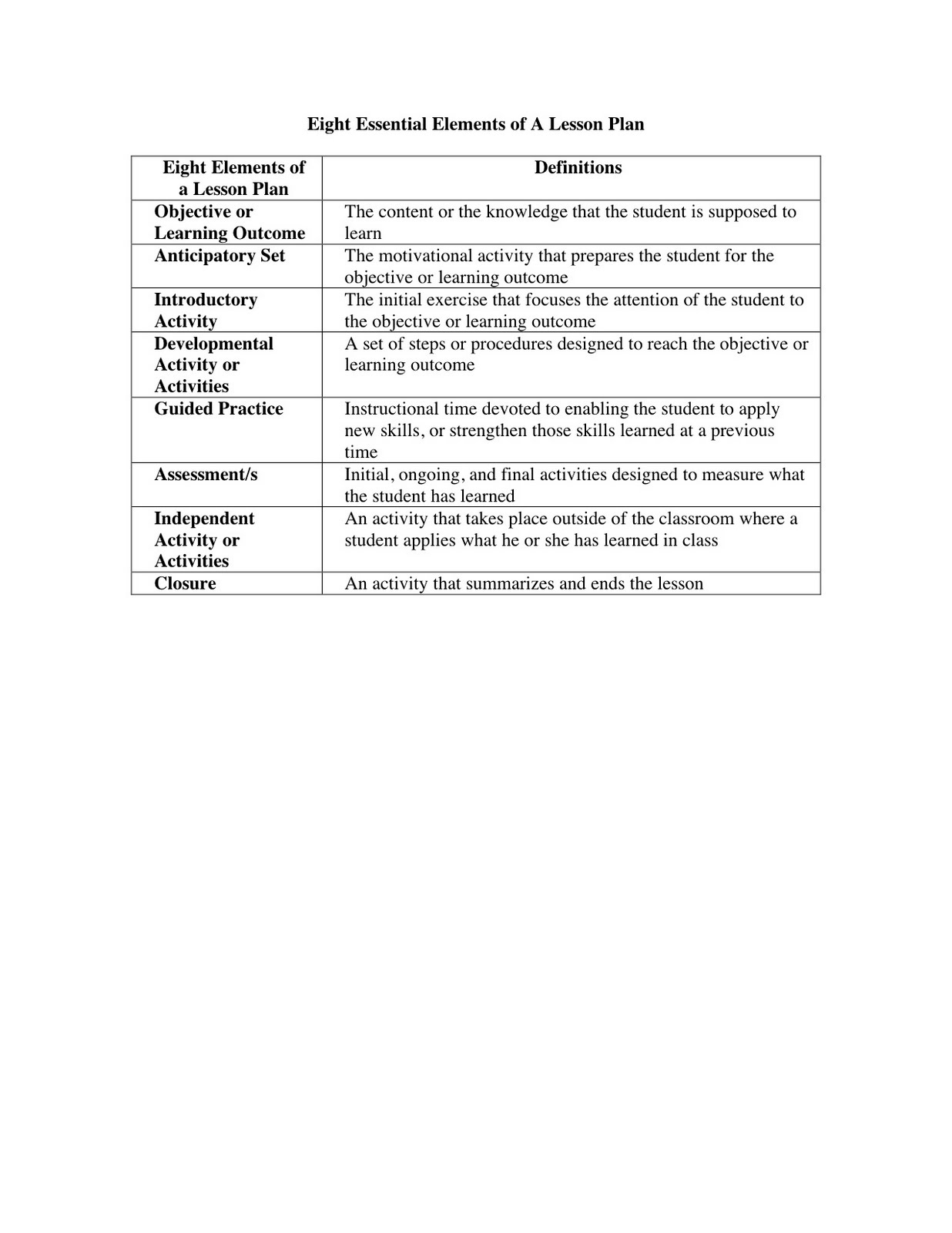
4. Explain the eight essential elements of a lesson plan according to Madeline Hunter which you can find at the top of this post : Eight Essential Elements of A Lesson Plan (Hunter, 1982)[1]

On the next post we will share the second part of this three part lesson on how to teach mentees to write lesson plans.

[1] These are the eight essential elements of a lesson plan according to M. Hunter (1982). Lesson plans, however, can also include other elements such as enduring Jewish knowledge, essential questions, standards, benchmarks, social skills, and thinking skills.

Monday, May 3, 2010

Title of the Lesson: Where Do I Find Enduring Jewish Knowledge? Part Three


When mentoring our pre-service and in-service teachers we need to describe and model both research-based and clinically tested best practices. This is one of many lessons we will be sharing on teaching Judaic content, lesson planning, models of teaching, differentiated and individualized instruction and learning activities designed to transform the classroom into a Jewish community of cooperative learners. The title of this lesson is “Can Students Generate Essential Questions that Relate to Jewish Knowledge that is Enduring? “ Since there are 13 elements in each lesson plan , we will divide this lesson plan into three parts. Here are the first and second parts of this lesson on finding enduring Jewish knowledge. The third part of this lesson follows:

Guided Practice: (Students apply new skill/s or strengthen previously learned skills during classroom instruction.)

1. When satisfied that your students understand the rules for Nominal Brainstorming, permit them to generate their ideas on how to find enduring Jewish knowledge.

2. Then share the information on finding enduring Jewish information in the Toolbox pages 17-18. You can also refer to the information below:

1. Ask yourself: What is the core, essential, or vital Jewish knowledge that I want my students to understand when they leave my classroom each day, at the end of the week, at the end of a unit, a semester or the year? In addition, what information is important, but not essential for my students to know? With what knowledge should educated Jewish students have some familiarity?
2. Ask your colleagues inside and outside of your school building, including the rabbi, principal, other teachers, professors, teacher specialists at the board or center for Jewish education, mentor teacher, expert teacher, etc., what Jewish knowledge is enduring.
3. Go to specific websites that contain information on the core knowledge that an educated Jewish person should understand. Here are a few examples:
For information on enduring understandings, core themes, sample lesson plans, and resources from the perspective of the Union of Reform Judaism, see the Chai Curriculum: Learning for Jewish Life .
For information on the standards and benchmarks from the perspective of the Jewish Theological Seminary click here .
For information on the aims, standards and benchmarks from the perspective of The United Synagogue of Conservative Judaism click here.
4. Read Jewish books and periodicals. Refer to the bibliography in the Toolbox for additional information.
5. Visit your local board, agency, or center of Jewish Education, and find its curriculum or resource library. Then investigate its print, visual materials, sound and musical recordings, computer files, and internet resources. For a select listing of agencies, and boards of Jewish education in the United States see the chart in chapter ten in the Toolbox. This chart also includes a brief description of curriculum resources.
6. Visit your local Jewish colleges or universities that have Jewish Studies Departments, and explore their Judaics, and curriculum libraries.

Independent Activities: (Students practice new skill/s or strengthen previously learned skills outside of the class.)

1. Students can ask their parents, grandparents, or another teacher these four questions: (1) Where does one find enduring Jewish knowledge? (2) Is enduring Jewish knowledge in the Torah? (3) Is enduring Jewish knowledge only in the Torah? (4) Is every word written in the Torah an example of enduring Jewish knowledge?

2. Students record the responses of the person they interviewed in their notebooks.

3. Students should be prepared to share what they had learned during the interview with their classmates.

Closure: (Activity that summarizes and ends the lesson)

Summarize the suggestions of the classroom community regarding how to find enduring Jewish knowledge.

On the next post we will begin our exploration of how to teach mentees to write lesson plans.

Jewish Education News Blog

Richard D. Solomon's Blog on Mentoring Jewish Students and Teachers

http://nextleveljewisheducation.blogspot.com/